Overbooking is a calculated bet, not a mistake. Here's how to size the bet, who to walk when it goes wrong, and when not to take it at all.
MH
Markus Hoffmann · Guest Author · Meridian Hotels
September 3, 2026 5 min read
Overbooking has a bad reputation earned entirely by how it is handled when it fails. Done deliberately, with a policy written in advance, it is ordinary inventory management. Done accidentally, or done deliberately with no plan for the failure case, it produces the worst guest experience a hotel is capable of delivering.
The math, in its simplest form
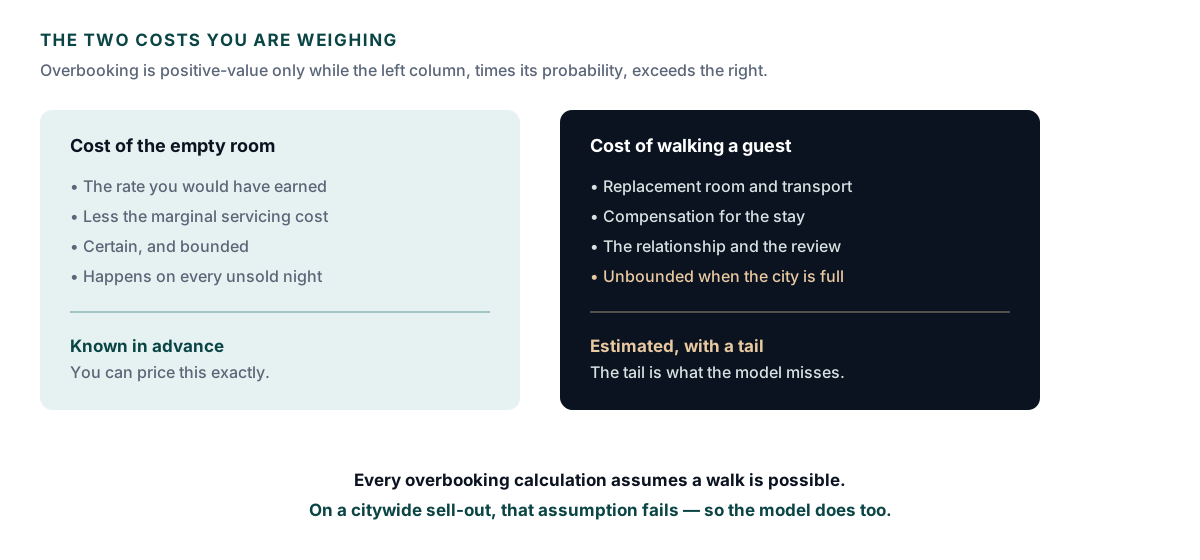
The decision is a comparison of two costs. On one side, the cost of an empty room you could have sold: your rate, less the marginal cost of servicing it. On the other, the cost of walking a guest: the replacement room, transport, whatever compensation you offer, and the harder-to-quantify cost of the relationship and the review.
Against those you weigh the probability that a booked room goes unoccupied — no-shows, same-day cancellations, early departures. If your no-show rate for a given night is meaningful and the cost of walking is not catastrophically higher than the cost of an empty room, some level of overbooking has positive expected value. The arithmetic is genuinely that simple.
The left column is knowable. The right has a tail, and the tail is the part the expected-value model leaves out.
The complication is that neither input is a single number, and treating them as single numbers is where most overbooking policies go wrong.
Why the naive version fails
A blanket no-show rate averaged across your whole book is close to useless, because no-show behavior varies enormously by how the booking was made.
Prepaid non-refundable bookings almost never no-show, and the ones that do have already paid you
Free-cancellation OTA bookings are a different population entirely, and the gap between the two can be very large
Corporate and negotiated-rate bookings behave differently again, often with predictable patterns around flight schedules
Group blocks have their own failure mode: they do not partially no-show, they release in a lump when the organizer cuts the block
The second failure is assuming no-shows are independent events. They are not. Weather, a cancelled flight, a conference that under-delivers — these produce correlated no-shows, which is the benign direction. The dangerous direction is correlated arrivals: the night everyone shows up is precisely the night your overbooking bet comes due, and it is usually a night with something happening in the city.
The practical consequence is that overbooking levels should be set per night and per segment mix, not as a standing percentage. A property that overbooks by a fixed three rooms every night is not managing risk; it is taking the same bet regardless of whether the odds are good.
Write the policy before you need it
The single largest determinant of how badly a walk goes is whether the person handling it is following a plan or improvising at 11pm. Decide these in advance, in writing, and make sure the night shift has them.
Who gets walked: typically the latest-arriving, shortest-stay, lowest-value guest — never a loyalty member, never a guaranteed-arrival booking, never a guest already in-house on a multi-night stay
Where they go: a specific named property of equal or better standard, with a relationship established beforehand rather than negotiated on the phone in front of the guest
What they get: transport both ways, the first night covered, and a defined gesture toward the rest of the stay — decided as policy, not improvised by whoever is on shift
Who has authority: the night manager must be able to execute the whole thing without waking anyone, or the policy is decorative
The pattern worth internalizing is that a walk handled generously and immediately is recoverable. A walk handled defensively, with the guest sensing that the hotel is trying to minimize what it gives them, is not. The compensation is rarely what determines the outcome — the speed and the absence of an argument are.
“The guest will forgive you for not having a room. They will not forgive you for making it their problem.
The operational tell
One practical detail separates properties that handle this well from those that do not: they identify the walk candidate early in the evening, not at the moment the guest arrives. If your overbooking is going to fail, you usually know by about 9pm — the arrivals list has stopped moving and the math no longer works.
Making the call then means you can contact the guest before they reach your lobby, arrange the alternative calmly, and have transport waiting. Making it when they are standing in front of you with luggage means every option is worse and the guest experiences it as a surprise rather than an arrangement.
When not to overbook
There are nights where the expected-value calculation says yes and the answer should still be no.
Citywide sell-outs, when there is nowhere to walk anyone to — the cost of a walk is not high, it is unbounded
Properties with no comparable alternative nearby, which describes most resorts and remote locations
Nights dominated by a single group or event, where the correlated-arrival risk is at its worst
Any night where your relocation partner is also full, which you should be checking rather than assuming
That first case is worth stating plainly because the model does not capture it. Every overbooking calculation assumes a walk is possible. On a night when the city is full, that assumption fails, and the downside is not a compensated inconvenience — it is a guest with nowhere to sleep and a story worth telling. Turn the overbooking off on those nights, even when the arithmetic is tempting.
Book a 30-minute demo. We'll walk through your specific property type, room count, and channel mix, then show you exactly what your data looks like on StaySynq.