What the night audit actually does, why it happens at 2am, and what a well-designed PMS should automate — and what it should never automate.
CD
Camille Dubois · VP Customer Success
September 3, 2026 4 min read
The night audit is the most misunderstood routine in hotel operations. New front desk staff learn it as a checklist to be survived. Owners see it as a report that appears in the morning. Very few people can explain what it is for, which is a problem, because everything downstream of it — your daily revenue figures, your occupancy history, your tax filings — inherits whatever it got wrong.
What it actually does
Strip away the property-specific variations and the night audit performs a small number of jobs.
Posts room charges and associated taxes to every in-house folio for the night that is ending
Rolls the business date forward, which is the step everything else depends on
Resolves the guests who should have arrived and did not, and the rooms that should have been vacated and were not
Freezes a snapshot of occupancy, rate, and revenue that becomes the historical record for that date
The fifth item is the one that matters most and gets the least attention. The night audit is the moment a day stops being editable and becomes history. Every report you run about last month is reading numbers this routine wrote.
Why it happens at 2am
The usual explanation is that the hotel is quiet then. That is a convenience, not a reason. The actual reason is the business date.
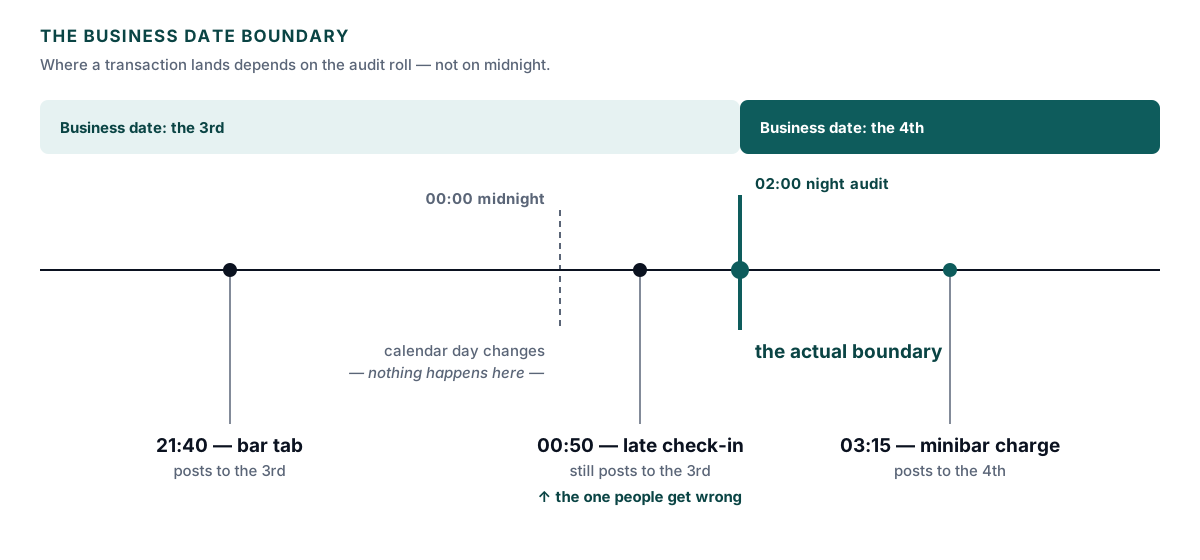
A hotel does not operate on calendar days. A guest who checks in at 11pm on the 3rd and leaves on the morning of the 4th has consumed one night, and that night belongs to the 3rd. A restaurant check rung at 1am belongs to the evening service that started the previous day. The business date is the operational day, and it does not align with midnight at any property with a bar.
Midnight is not the boundary. The audit roll is — which is why a 00:50 check-in still belongs to the previous business date.
The audit runs at the point where the fewest transactions are in flight, and rolling the business date there minimizes the number of charges that land on the wrong side of the boundary. Anything posted after the roll belongs to the new day, whether or not the person posting it realizes that. This is the single most common source of night audit confusion, and it is worth teaching explicitly to anyone working a late shift.
Where it goes wrong
The failures are consistent across properties and almost all of them are timing problems rather than arithmetic problems.
Departures that were never checked out, so the system posts another night's room charge to a guest who left that morning
Arrivals marked as no-show that actually arrived late, stranding a reservation and a deposit
F&B charges from a third-party POS that sync after the roll and land on the wrong business date
Payment gateway settlements that batch on the provider's schedule rather than yours, so the day's cash never quite reconciles
An audit that fails partway through and gets re-run, posting some charges twice
That last one deserves particular care. A night audit must be safe to re-run — if a step fails halfway, running it again should complete the remaining work without duplicating what already succeeded. A routine that cannot be safely repeated turns a small failure into a reconciliation exercise across every folio in the house.
What automation should and should not do
Every modern PMS advertises an automated night audit, and the phrase covers two quite different things.
The mechanical work should absolutely be automated. Posting room and tax to several hundred folios is arithmetic, and a human doing it by hand at 2am is a source of errors rather than a control. Rolling the date, generating the reports, and closing the cashier shifts are the same. Nobody should be typing during any of this.
The judgment should not be automated silently. Deciding that a guest is a no-show, that an open folio should be force-closed, or that an unmatched payment should be written off are decisions with financial consequences. A system that resolves these quietly at 2am and presents a tidy report in the morning has not removed the work — it has removed your visibility into it.
“Automate the arithmetic. Surface the judgment. A night audit with no exceptions report is hiding something.
Reading the output
If you only look at one thing each morning, make it the exceptions list rather than the revenue summary. The revenue number is what you hope happened. The exceptions are where the number might be wrong.
Three specific figures are worth checking daily: the count of folios with a non-zero balance for guests who have departed, the total of any suspense or unallocated payment account, and the difference between the gateway's settled total and your posted payment total. Each should be near zero. Each drifting upward over a week is an early signal of something structurally broken, usually in an integration.
The night audit is not glamorous and no guest will ever notice it. It is, however, the routine that decides whether your reporting describes your hotel or merely resembles it — which makes it worth understanding properly rather than simply running.
Book a 30-minute demo. We'll walk through your specific property type, room count, and channel mix, then show you exactly what your data looks like on StaySynq.